


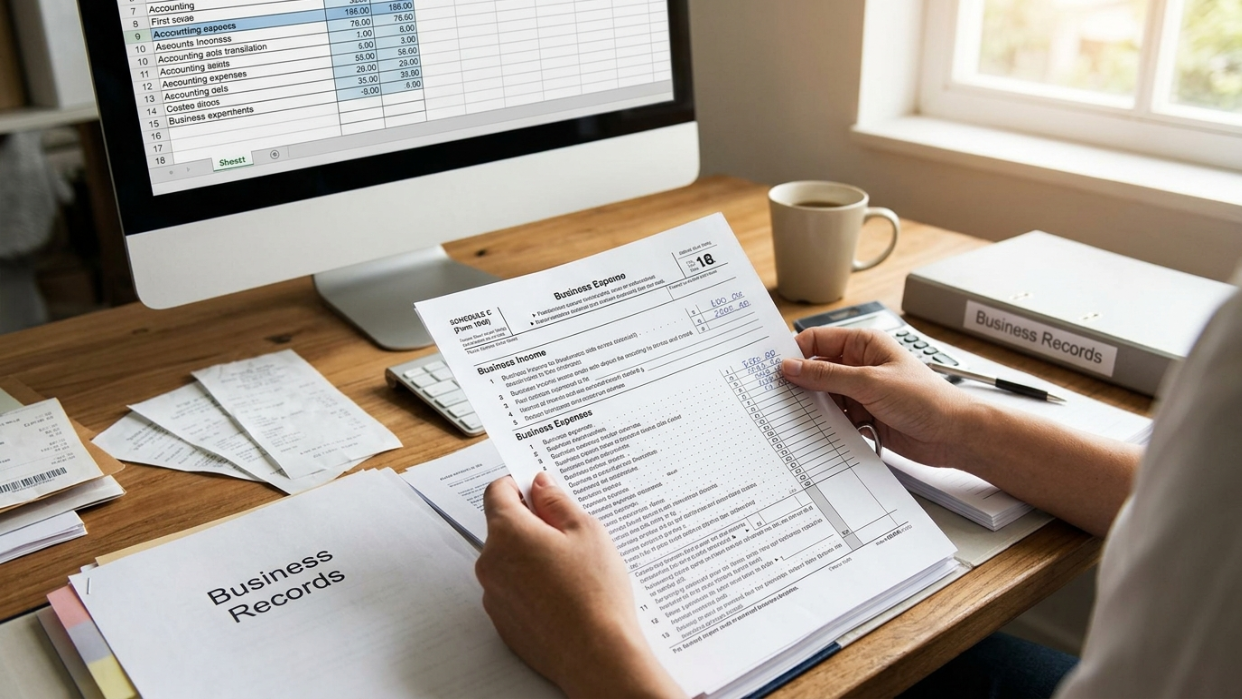
About Course
Schedule C Essentials: Reporting Business Income and Expenses
General Information
Course Description
Over the past five years, self-employment in the United States has grown steadily. According to the Bureau of Labor Statistics, approximately 16.4 million Americans identified themselves as full-time self-employed workers in 2023, while nearly 58 million performed some type of freelance work during the year.
This growth has created significant tax compliance challenges, as many individuals begin their businesses without understanding the federal tax implications of Schedule C. Mastering this return is essential for tax preparers, advisors, and entrepreneurs working with sole proprietorship clients.
This course covers everything from advanced income and expense classification to legal tax reduction strategies, supported by practical case studies and official IRS guidance.
Course Objective
Master the proper classification, reporting, and deduction of income and expenses related to self-employed business activities, optimizing the use of Schedule C to comply with IRS regulations while taking advantage of every legal opportunity to reduce tax liability.
Learning Objectives
- Identify the various types of income and expenses that must be reported on Schedule C.
- Classify deductible expenses according to official IRS categories.
- Apply deductions for home office, vehicles, equipment, and machinery.
- Correctly use Form 8829, Form 4562, and mileage records.
- Compare MACRS, Section 179, and bonus depreciation.
- Apply legal tax planning and optimization strategies.
Industry Insights
- More than 27 million people in the United States report self-employment income each year (SBA, 2023).
- Approximately 70% of new businesses begin as sole proprietorships.
- About 25% of Schedule C returns contain errors that may trigger IRS audits.
- Proper deductions can reduce annual tax liability by more than 30%.
- Approximately 40% of small business audits result from errors in income and expense classification.
- The average underreported amount identified by the IRS is approximately $2,600 per year.
Who Should Take This Course
- Tax preparers serving sole proprietorship clients.
- Accountants and tax advisors.
- Freelancers and self-employed individuals.
- Small business owners.
- Accounting and finance students.
Course Content – 10 Modules
| # | Title | Description |
|---|---|---|
| 01 | Advanced Income and Expense Classification | Cash income, Forms 1099, digital platforms, and barter transactions. |
| 02 | Common Adjustments and Corrections | Frequent filing mistakes and the use of Form 1040-X. |
| 03 | Maximum Deduction Strategies | Optimizing ordinary and necessary business expenses. |
| 04 | Home Office Requirements | Simplified method versus the regular method. |
| 05 | Standard Mileage vs. Actual Expense Method | Comparison of the two vehicle deduction methods. |
| 06 | Form 8829 and Recordkeeping | Home office deductions and mileage documentation. |
| 07 | MACRS and Asset Recovery Periods | IRS depreciation rules for business assets. |
| 08 | Section 179 and Bonus Depreciation | Immediate expensing versus regular depreciation. |
| 09 | Practical Case Studies | Equipment, machinery, and vehicle examples. |
| 10 | Audit Risk and Tax Compliance | Documentation, receipts, and defending a return before the IRS. |
What You Will Achieve
- Accurately report business income.
- Properly classify deductible business expenses according to IRS guidelines.
- Apply vehicle and home office deductions correctly.
- Use MACRS, Section 179, and bonus depreciation effectively.
- Correctly complete Form 8829.
- Reduce the risk of IRS audits.
Course Materials Included
- Textbook: Schedule C Essentials – Reporting Business Income and Expenses
- IRS Schedule C (Form 1040).
- Form 4562.
- Form 8829.
- IRS Publication 535.
- IRS Publication 583.
- MACRS depreciation tables.
- Practical case studies.
Frequently Asked Questions
Student Ratings & Reviews
