


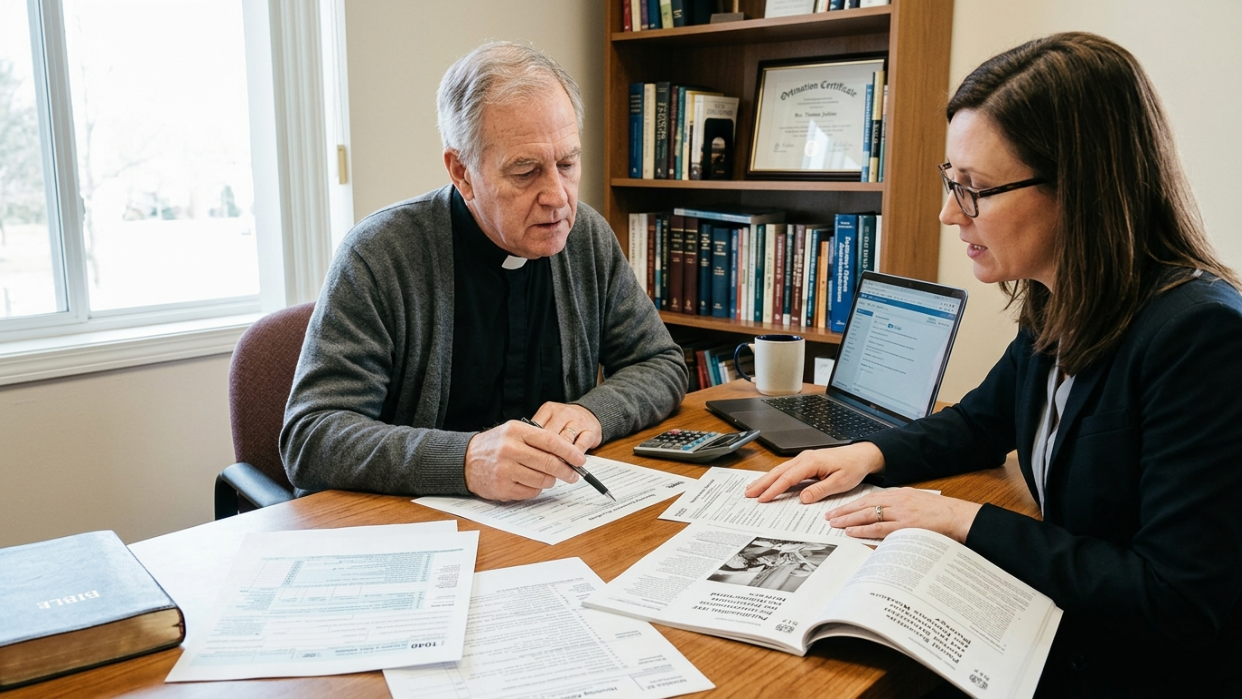
About Course
Tax Rules for Ministers and Clergy
General Information
Course Description
The Tax Rules for Ministers and Clergy course explains the federal tax rules that apply to ministers, clergy members, and other religious workers.
The course covers the dual-status rule, under which a minister may be treated as an employee for federal income tax purposes while simultaneously being considered self-employed for Social Security and Medicare taxes under SECA.
It explains the housing allowance and parsonage exclusion under IRC §107, the calculation of net ministerial earnings on Schedule SE, exemption through Form 4361, accountable reimbursement plans, and the reporting requirements for ministerial compensation.
Additional topics include honoraria, love offerings, professional expenses, denominational pensions, multiple congregations, and transitions between ministerial and secular employment.
Practical applications include complete examples of the three-part housing allowance limitation test, the mandatory SECA add-back of the housing allowance, preparation of Form W-2 and Schedule SE, documentation analysis, and Circular 230 professional standards.
The course emphasizes common compliance errors and provides practical review methodologies that help tax professionals prepare accurate and well-documented federal tax returns.
Course Objective
Provide participants with the knowledge and practical skills needed to determine the federal tax status of ministers, properly apply the housing allowance exclusion, calculate self-employment taxes, evaluate eligibility for Form 4361, and prepare compliant federal tax returns for clergy members.
Learning Objectives
- Differentiate employee status for federal income tax purposes from self-employed status under SECA.
- Apply the Knight v. Commissioner factors to determine who qualifies as a minister.
- Calculate the housing allowance or parsonage exclusion using the three-part limitation test under IRC §107.
- Prepare Schedule SE, including the required housing allowance or fair rental value for SECA purposes.
- Determine eligibility, filing deadlines, and tax consequences of Form 4361.
- Distinguish accountable plans from nonaccountable plans and evaluate ministerial expenses.
- Review Form W-2 reporting, love offerings, pension income, multiple employers, and international situations.
Who Should Take This Course
- Enrolled Agents (EAs) and tax professionals with a PTIN seeking continuing education in Federal Tax Law.
- Tax return preparers serving ministers, pastors, priests, and other clergy members.
- Church administrators and religious organization personnel involved in compensation planning and tax reporting.
- Professionals who prepare returns involving housing allowances, parsonage benefits, Schedule SE, or Form 4361.
- Tax professionals who want to reduce errors and improve documentation when preparing clergy tax returns.
Course Content – 11 Modules
| # | Title | Description |
|---|---|---|
| 01 | Federal Status and the Dual-Status Rule | Employee classification for income tax purposes and self-employed status under SECA; Knight v. Commissioner factors and the distinction between ministerial and secular income. |
| 02 | Housing Allowance and Parsonage Under IRC §107 | Housing exclusions, limitation tests, required documentation, and taxable excess amounts. |
| 03 | Self-Employment Tax and Schedule SE | Calculating net ministerial earnings, mandatory housing allowance add-back, and estimated tax payments. |
| 04 | Form 4361 and SECA Exemption | Eligibility requirements, filing deadlines, IRS approval, and tax consequences. |
| 05 | Ministerial Expenses and Accountable Plans | Business expenses, reimbursements, and documentation requirements. |
| 06 | Compensation Reporting and Compliance Issues | Preparation of Form W-2, ministerial compensation, and common reporting errors. |
| 07 | Worked Examples and Practical Case Studies | Numerical illustrations and real-world tax scenarios. |
| 08 | Pensions and Special Situations | Ministerial pensions, multiple congregations, and special tax rules. |
| 09 | Circular 230 in Clergy Engagements | Due diligence, documentation standards, and professional compliance. |
| 10 | Audits, Recordkeeping, and Advanced Housing Issues | Documentation methods and audit preparation strategies. |
| 11 | Missionaries and International Assignments | Religious services performed abroad and applicable international tax rules. |
What You Will Achieve
- Apply a systematic approach to properly classify ministerial and secular income.
- Determine the allowable housing allowance exclusion.
- Calculate net ministerial earnings and self-employment tax.
- Evaluate filing deadlines and long-term consequences of Form 4361.
- Identify accountable reimbursement arrangements and required documentation.
- Review ministerial compensation and Form W-2 reporting.
- Handle pensions, multiple congregations, and international tax situations.
Course Materials
- Complete Course Manual: Tax Rules for Ministers and Clergy
- Program syllabus containing eleven instructional modules and assessment structure.
- References to IRC §§107, 1402, 265, and other applicable authorities.
- Form 4361, Schedule SE, Form W-2, Form 1040-ES, and related IRS forms.
- Worked examples covering housing allowance, parsonage, and SECA calculations.
- Documentation guides and Circular 230 reference materials.
- Review questions, final examination, and Course Evaluation Form.
Assessment
| Component | Requirement |
|---|---|
| Format | QAS Self-Study program with sequential reading requirements. |
| Review Questions | 6 formative self-assessment questions. |
| Final Examination | 10 multiple-choice questions. |
| Minimum Passing Score | 70% |
| Additional Requirement | Submit the Course Evaluation Form. |
Frequently Asked Questions
Student Ratings & Reviews
